
Let's start with what you've probably already tried
You've spent time alone. You've watched videos, read guides, bought toys that promised results. Your partner has tried. You've tried harder. And yet. Nothing. Or worse: something happens, but it's so faint or take-it-or-leave-it that you wonder if you're actually feeling anything at all.
Here's the thing: orgasm isn't a binary switch. It exists on a spectrum, and if you've never experienced a genuinely satisfying one, you might be looking for the wrong sensation in the wrong place with the wrong technique. That's not a failure. That's just incomplete information.
Why standard vibration doesn't always work
Most vibrators buzz. Back and forth, up and down, repetitive stimulation. For some people, this builds sensation beautifully. For others, it creates exactly nothing. The problem isn't you. The problem is the mechanism.
Standard vibration requires a specific nerve response: the ability to feel the oscillation and translate it into arousal. But some nervous systems don't build sensation that way. Some people need suction instead. Some need pressure. Some need a combination that changes as arousal builds.
A lemon vibrator works on a completely different principle. Instead of vibration, it uses air-pulse technology. Think of it as gentle suction that stimulates the entire clitoral complex, not just the tip. It's the difference between a single point of friction and a broader wave of sensation.
How air-pulse lemon vibrators actually feel different
When you first try a lemon clitoral vibrator like the ones Nancy's Lemss designs, the sensation is immediately distinct from traditional vibrators. It feels less like buzzing and more like a gentle, rhythmic suction that pulls sensation toward you rather than pushing into you.
This matters because the clitoris isn't just the tiny bump you can see. It's got internal branches that extend into the body. A lemon vibrator's air-pulse technology stimulates the whole structure, which creates deeper, more diffuse sensation that many people describe as more intense and more full-bodied than simple vibration.
The setup that actually matters
If you've never had a satisfying orgasm, here's what changes everything.
First: time. Budget 20 to 40 minutes minimum. Not because you're broken, but because if your body hasn't learned the path to orgasm yet, rushing it guarantees failure. Pleasure requires a relaxed nervous system, and relaxation takes time.
Second: context. You need zero pressure to perform. No "this better work this time." No partner waiting. No checking the clock. If you're trying a lemon vibrator for the first time, do it alone, with a lock on the door, and with the explicit knowledge that the goal is exploration, not orgasm. Ironically, the goal-free approach is what makes it work.
Third: lubrication. Even if you're self-lubricating plenty, water-based lube changes the sensation dramatically. It reduces friction, allows the suction to work more effectively, and makes the whole experience feel less like work and more like pleasure.
Fourth: your body position. Lie down, half-reclined against pillows. Not flat on your back (it's hard to focus), not sitting up completely (your legs get tired). The position where you can relax completely and still have easy access to your clitoris.
How to actually use a lemon vibrator if nothing's worked before
Start at the lowest setting. With a lemon clitoral vibrator, the lowest setting is often where the magic starts, especially if you've been trying aggressive vibration. You're not looking for intensity right away. You're looking for a sensation you can actually feel building.
Place the opening against your clitoris gently. Not with pressure. Just contact. Turn it on at level one and notice what happens. This isn't the moment to find your orgasm. This is the moment to find the sensation that makes you want to keep going. That's different for everyone.
Once you've found level one feeling good, stay there for five to ten minutes. Yes, really. Your nervous system needs time to recognize this as a pleasure signal. While you're there, notice: does the sensation build? Does it spread? Do you feel more responsive after a few minutes than you did at the start? These questions matter more than reaching a peak.
After ten minutes, if you're feeling more sensation, try level two. Again, patience. Some people need to stay here for another ten minutes. Some are ready to shift after two. There's no timeline except the one your body provides.
If at some point it doesn't feel like it's going anywhere, don't abandon it. Just switch to direct clitoral contact without the toy, using your hand or a partner, and see if that changes anything. Sometimes the combination works better than the toy alone. Sometimes you need five minutes of the toy followed by five minutes of something else. Your body will tell you what works if you listen without judgment.
The mental piece (which is actually the crucial piece)
Here's what I see in my practice: people who've never had an orgasm often carry a story that something's wrong with them. That story is the real barrier.
Orgasm is partly neurological, partly physiological, and hugely psychological. If you're using a lemon vibrator while thinking "this probably won't work" or "something must be broken in me," your nervous system is in a subtle state of self-protection. That state makes orgasm nearly impossible.
Instead, try this: assume your body is normal and responsive, and that you simply haven't found the right stimulus yet. That shift is not positive thinking nonsense. That's basic neuroscience. Your brain literally down-regulates pleasure signals when it perceives threat. Removing the threat (the belief that something's wrong with you) is often all that's needed.
During exploration, if your mind starts narrating ("this is taking too long," "I'm doing it wrong," "it's not happening"), that's normal. Just notice the thought and redirect to the physical sensation instead. "What am I feeling right now?" is always a better question than "why isn't this working?"
When to try a partner and when not to
If you're in a relationship, here's my strong suggestion: figure out the orgasm part alone first. Once you know what sensation works and how your body responds, then bring your partner into it. Trying to learn your own pleasure response while managing someone else's expectations or presence is exponentially harder.
That said, many people find that how to use a lemon vibrator when you have mismatched desire with a new partner requires open communication about what you're discovering. Once you've had some solo success, telling your partner "I found something that works, and here's what it feels like when it does" is radically different from "I'm using a vibrator because you haven't been able to make me orgasm."
The timeline reality
Some people try a lemon vibrator and have their first real orgasm in the first session. Others need a week of regular exploration before it clicks. Some take two weeks. There's no "too long." You're literally rewiring your nervous system's understanding of what pleasure is. That takes time.
Consistency matters more than intensity. Using a clitoral vibrator for fifteen minutes three times a week will likely get you there faster than an hour-long marathon session once a month. Your nervous system learns through repetition and pattern recognition.
If you're rebuilding pleasure after relationship trauma or recovering from a period where pleasure felt inaccessible, expect the timeline to be longer. That's not failure. That's healing.
What changes when it actually works
When you have your first real orgasm, it doesn't always feel like what you expected. Sometimes it's waves. Sometimes it's a sudden release. Sometimes it's a fullness that builds and peaks. Sometimes it's surprisingly subtle at first, then deepens over weeks of use.
Once you know what sensation leads there, the next orgasm becomes easier to access. And the one after that, easier still. Your body starts to recognize the pathway. That's the moment when lemon vibrators become genuinely transformative, not because they're magical, but because they finally answered the question your body's been waiting for: "What does pleasure actually feel like for me?"
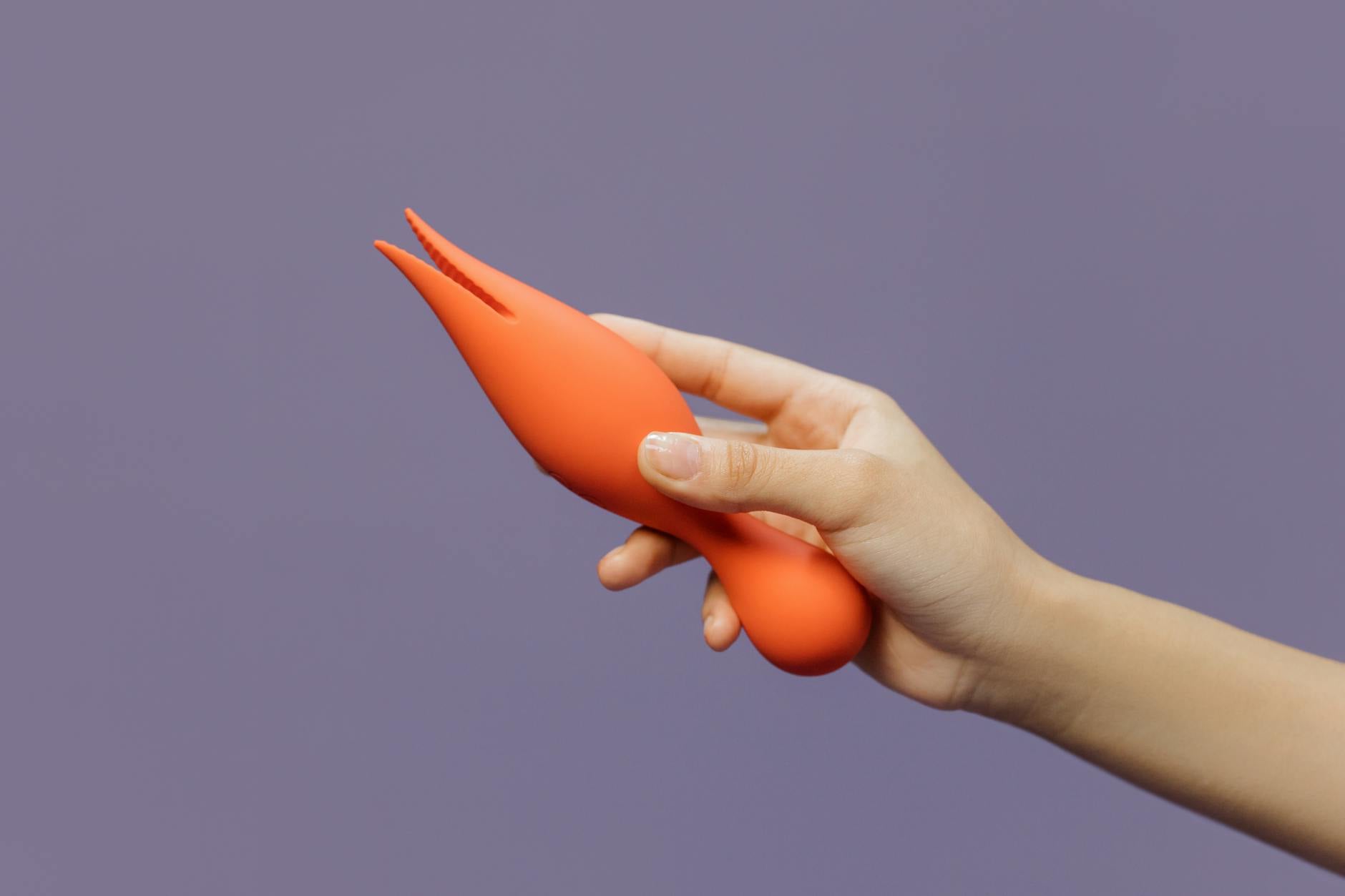
Photo by cottonbro studio on Pexels
FAQ: Deeper questions about lemon vibrators and first orgasms
What's the actual difference between a lemon vibrator and a regular vibrator?
A lemon vibrator uses air-pulse or suction technology, while regular vibrators use oscillation. The sensation spreads across the clitoral complex rather than concentrating on a single point. For people whose bodies don't respond to vibration, this difference is the whole ballgame. Lemon clitoral vibrators from Nancy's Lemss, for example, are specifically designed for this broader stimulation pattern.
Is it normal that I've never had an orgasm at 25 (or 35, or 45)?
Completely normal. About 10 to 15 percent of people with vulvas never experience orgasm, and another 40 percent experience it inconsistently. You're not broken, not frigid, not defective. You're someone whose body has a different pleasure pathway than the mainstream narrative assumes.
Should I use lube with a lemon vibrator?
Yes. Water-based lube makes air-pulse technology work more effectively and makes the sensation less intense if you're sensitive. It also reduces the risk of irritation if you're exploring for longer sessions.
Can I use a lemon vibrator with a partner, or should I keep it solo?
Both work. Solo exploration first helps you learn your own response without pressure. Once you know what works, many couples find that a partner can operate the lem vibrator while providing other touch, which can deepen sensation and intimacy.
What if I'm on antidepressants that affect sensation?
Lemon vibrators often work particularly well for people on SSRIs or other medications that dampen sensation. The broader stimulation pattern and suction technology can bypass some of the dampening effect. That said, if sensation is severely blunted, talk to your doctor about dosage or timing before assuming the toy is the issue.
How long does it actually take to have your first orgasm with a lemon vibrator?
Anywhere from the first try to several weeks of regular exploration. The average I see in practice is three to five sessions. Consistency matters more than the length of each session. Fifteen minutes three times a week beats a ninety-minute monthly marathon.
One more thing
Orgasm matters. Not because society says it should, and not because your partner expects it, but because pleasure is a form of self-knowledge. Learning what your body responds to, what sensation creates that rush, what rhythm takes you to that peak. that's valuable information about who you are.
If you've never had one, that information's been missing. A lemon vibrator isn't magic, but it's often the tool that finally fills that gap. And once you know what pleasure feels like in your body, everything changes. Not just sex. Your relationship to your body, your baseline stress, your sense of agency. All of it.
If you want to talk through what might be blocking you, or if you want specific guidance on technique or product fit, reach out. That's exactly what we're here for.